

To Our Shareholders and Investors

October 2026
Sanwa Holdings Corporation
Representative Director,President
Yasushi Takayama
As We Mark Our 70th Anniversary in April 2026
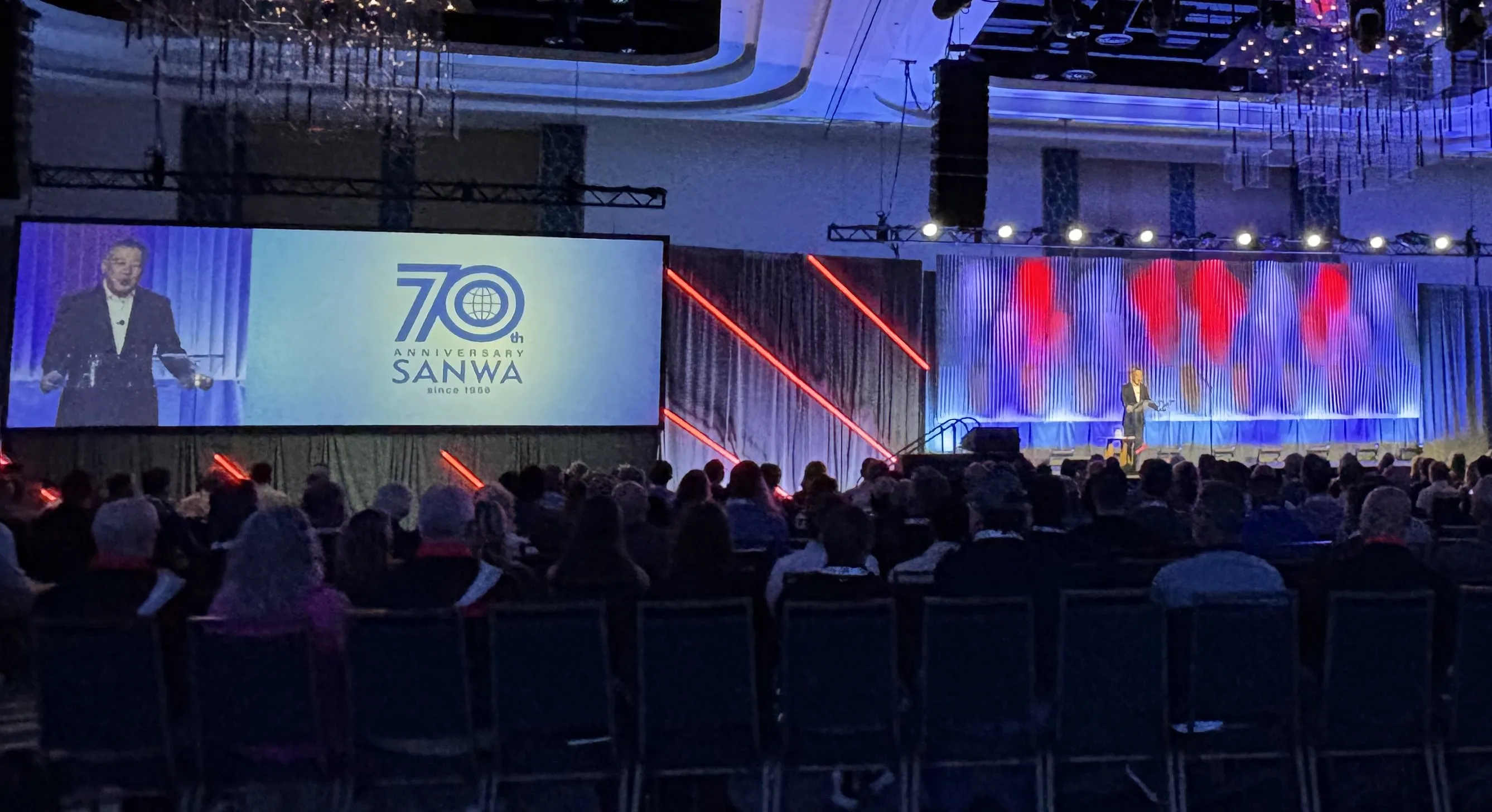
Reaching the milestone of our 70th anniversary is entirely thanks to all of our stakeholders who have given us their support, and I am deeply grateful to them. We have received many encouraging messages of congratulations from our business partners, but what has stood out most are the words of praise regarding our business growth and progress toward globalization in recent years.
A short time ago, Overhead Door Corporation (ODC), a U.S. company and Sanwa subsidiary celebrating its 105th anniversary this year, held its distributor meeting in San Diego, and I attended for the first time in a while. I was able to meet in person with representatives from parties that have been important ODC customers and partners for over a century, and personally express my gratitude to them as our own enterprise reaches its 70th anniversary. As I've had the opportunity to interact more closely with our stakeholders, I've come to keenly feel their expectations, and I've renewed my resolve to approach management with diligence so that we may continue to advance and grow for many more years to come.
The Factors Behind Our Long-Term Business Success
Reflecting on the reason why we've been able to stay in business all this time, I feel the answer ultimately lies in the enduring characteristics of shutters-that is, the ubiquitous value they provide as a technology which, while by no means flashy, blends seamlessly into buildings and daily life as something that is always needed. That being said, this alone of course does not explain why we have been able to survive for so long. We take pride in the fact that the recognition we have received from our customers and the market is the result of our unique approach. This includes not only the obvious initiatives of ensuring product quality and safety, but also of taking full responsibility for installation and maintenance, as well as our ability to meet a wide range of customer needs. We don't just make and sell shutters and other building materials; we also engage in their development, production, design, marketing, installation, and maintenance. This unique business model creates a barrier to entry that other companies cannot easily replicate, contributing to our high market share. Furthermore, rather than simply pursuing product differentiation, the know-how and experience we have accumulated over the years in such areas as safety features for crime prevention and disaster preparedness, as well as safe opening and closing operations, contribute to the distinctive value that we provide. In addition, we are deeply committed to installing and maintaining the products we manufacture ourselves, and this integrated approach is a key factor in enhancing both quality and safety.
Further, looking back at Sanwa's history, our pioneering expansion into overseas markets served as a major turning point that supported our sustained growth. It all began with our technical partnership with ODC in the U.S. in 1974. Taking full advantage of this opportunity, we conducted a thorough investigation into the U.S. market, the characteristics of our partner, and alignment with our company. We then made the decision to acquire ODC in 1996, marking the start of our full-scale global expansion. The Japanese economy at that time was in a period of turmoil following the bursting of the economic bubble, and I understand that Sanwa, like many other companies then, was facing its share of difficulties. I think it's clear that one of the reasons management at the time made the bold decision to fully step out into the international market was a sense of crisis regarding the prospect of continuing to operate solely in the Japanese market, where significant, sustained growth could not be expected. I also imagine, however, that this sense of crisis alone may well not have been enough to give Sanwa's leadership the courage to take that first step. In fact, I suspect it may have been more a matter of pure curiosity and a spirit of adventure-a desire to push beyond one's limits, see the globe, and take on the world. Regardless as to the specific reasons why, as a result of that momentous decision, our global operations now consist of a four-pole structure encompassing Japan, North America, Europe, and Asia, which serve as the pillars driving our growth.
Our Focus in Sanwa Global Vision 2030
The business environment is undergoing significant changes, including the maturing of the domestic Japanese market, labor shortages, the worsening of climate change issues such as increasingly severe natural disasters, and the advancement of digitalization. Against this backdrop, in 2022 we launched our Long-Term Vision, Sanwa Global Vision 2030, to serve as a compass, both to those within the Sanwa Group and those outside it, and point to where we as Sanwa should be heading. In particular, as social structures change, infrastructure and technology continue to advance, and customer needs for our products become more sophisticated and complex, we have come to realize that we must also evolve the value we provide.
We have set forth our vision, "To be a global leader of smart entrance solutions," but what I focus most on here is the "solutions" component. We have more clearly articulated our strategic direction, which goes beyond simply selling, installing, inspecting, and repairing products as we have done in the past-instead, we aim to provide more advanced solutions by adding value and new features, and to roll these out globally. We previously used the term "major global player" to describe our vision, but in our current vision, we have taken our ideal for our future state a step further with the aspiration to be a solutions leader in our industry, and therefore now use the term "global leader." As we continue to enhance our solutions, our greatest advantage is the direct contact we have with our customers through installation and maintenance. The key will be how effectively we can identify demand by addressing customers' problems and challenges, and then create solutions through collaboration with business partners and various other stakeholders, as well as by leveraging the latest technologies. Under our current medium-term management plan, "Expand business through disaster preparedness products, climate change response products, and smart products and services" is identified as one of our basic strategies, and we have positioned it as the most emblematic strategic theme for realizing our vision.
On the other hand, "what will remain unchanged" is also an important guiding principle, and we have no intention of changing the nature of our business itself, which centers on shutters and other products for entrances. This is by no means a matter of sentimentality regarding our founding legacy; rather, it is based on the highly rational reason that we have established a highly profitable business model. Of course, it is not guaranteed to last forever, but we will continue to carefully protect and develop this core revenue pillar, maintain a high market share, and use it as a springboard to expand into related fields and broaden our global reach.
Looking back on the four years since the launch of the Sanwa Global Vision 2030, while our recent business performance has struggled due to a confluence of various external factors, we are encouraged by the significant growth we achieved in our U.S. operations during the previous medium-term management plan period (fiscal 2022 to 2024), the fact that our capital and IT investments are proceeding as planned, and the steady expansion of our key disaster preparedness and climate change response products. It is therefore our perception that we have achieved a certain degree of results in building up our business foundation. On the other hand, for the Company, which advocates ROIC-based management, improving the profitability of our European operations and achieving profitable growth in our Asian operations are key challenges moving forward. However, in addition to the benefits of regional diversification, lifecycle management tailored to each market is a key factor for our sustainable growth. Going forward, we plan to not only strengthen our operations in Asia but also aim to expand into other regions where we currently have no presence. Our mission is to deliver safe, secure, and convenient products and solutions across the globe, and that is the mindset with which we view the world.
Progress in the First Year of the Medium-Term Management Plan 2027
Medium-term Management Plan 2027, which began in the fiscal year ended March 2026, is the second phase toward realizing the Sanwa Global Vision 2030. It is positioned as a stage in which we shift gears from "establishing a foundation" in the previous medium-term management plan to "strengthening and expanding that foundation." That said, our strategic direction has not changed significantly from the previous medium-term management plan. We are continuing to move forward with our initiatives in line with the five basic strategies outlined in our vision.
For the fiscal year ended March 2026, the plan's first year, financial performance was generally weak compared to the previous medium-term management plan, which had seen strong results, due to a combination of various external factors. In particular, North America saw a delayed market recovery due to factors such as the impact of tariffs and persistently high interest rates, while in Europe, market conditions remained uncertain, including the situation in the Middle East, resulting in sluggish growth in our overseas operations. In Japan as well, sales volumes of core products such as shutters and doors declined due to factors including delays and prolonged construction periods in large-scale urban development projects, driven by soaring construction material costs and labor shortages. However, our operating profit ratio improved significantly thanks to the expansion of high-value-added, high-margin climate change response products and our maintenance and service operations, as well as the successful passing on of cost increases. This improvement in the operating profit ratio helped underpin overall earnings and is a positive sign for the future.
On the other hand, looking at the progress of our basic strategies, we have found ourselves somewhat playing catch-up as we've been preoccupied with responding to the sluggish market. However, in addition to expanding our key disaster preparedness and climate change response products, as well as smart products and services, our investments in increasing production capacity and advancing digitalization are proceeding smoothly. Particularly with regard to disaster preparedness and climate change response, products such as Quick Saver have seen significant growth in our domestic Japanese market as solutions that address the need to improve workplace environments at plants and other facilities. This accordingly can truly be considered a symbolic example that illustrates the path toward strengthening our solutions. We are also working to expand our lineup of products that support a decarbonized society, such as launching heavy-duty doors that incorporate GX (green transformation) steel, a material designed to reduce environmental impact. In addition, we are focusing on IoT initiatives, such as the rollout of our newly launched remote management system. As a service that allows users to check the operational status of shutters and other equipment via a computer without having to physically visit the site, it is an effective means of addressing labor shortages in building management. In North America as well, we are advancing the digitalization of systems related to entrances, and we have acquired Pasco Doors, an automatic door service company, to diversify our revenue streams by strengthening our service and installation structure. Going forward, it is important that we continue to grow sales of high-value-added products through solutions like these.
Furthermore, while our Asian operations are still small in scale and have only just managed to turn a profit, we will move forward with structural reforms in our struggling East China operations, while also focusing on growth in Hong Kong and Taiwan-where business is relatively strong-and expanding our presence in the ASEAN region. In any case, we need to ensure we have the necessary structure in place so that we can effectively capture demand when our main markets in Japan, North America, and Europe recover. We will move forward with transforming our revenue structure through measures such as passing on price increases, reducing costs, and expanding our service operations, while also focusing our efforts on investments to increase production capacity and improve productivity. Furthermore, even if a delay in market recovery were to affect our business expansion, we are committed to ensuring that we achieve the operating profit ratio target set forth in our current medium-term management plan.
Challenges for Sustainable Long-Term Growth
We recognize that strengthening our human capital is our greatest challenge, not only for realizing Global Vision 2030, but also for achieving sustainable growth beyond that. In particular, we must strive for qualitative improvement. Of course, it goes without saying that our human capital has been the foundation of our value creation to date. We take pride in the fact that our employees' dedication, commitment to their work, and passion for our products are major strengths for our Group. However, I feel that in order to strengthen our solutions as outlined in Global Vision 2030, we also need flexible and creative thinking that drives high productivity. Although I stated that the focus of our operations on shutters itself will not change, the expectations placed on shutters and the capabilities they offer will likely expand in line with technological advancements and the challenges users face. We must therefore identify the business opportunities therein and, without being constrained by past ideas or concepts, propose new functions and applications. We may also need to be flexible in terms of redefining how and to whom we sell.
Furthermore, as we move forward with our global expansion, developing and securing global human capital is an urgent priority. As we consider expanding into Asian, African, and other markets in the future, a shortage of global talent could become a critical bottleneck. While developing domestic human resources is important, I feel we have reached a point where we should also turn our attention to talent at our overseas subsidiaries and consider identifying and promoting individuals with the skills and mindset to thrive on a global stage through initiatives such as personnel exchanges within the Group. In addition to addressing labor shortages caused by the declining population in Japan, adapting to digitalization to improve productivity and add value has also become a challenge that must be tackled on a global level. We are addressing this point as one of the basic strategies of our current medium-term management plan, and through IT investments totaling ¥10 billion over three years, we are working to improve business processes and boost productivity in Japan, North America, and Europe.
I also believe that realizing the M&A for which we have secured a budget of ¥50 billion over three years is a strategic initiative that presents significant challenges. A key feature of our business is that our investment in equipment and other assets yields high returns, resulting in a superior revenue model that naturally generates abundant cash flow. Making effective use of our substantial cash reserves is a top priority in our ROIC-based management, and our M&A strategy also plays a significant role in this. However, it is not our intention for M&A to become an end in itself; rather, we plan to flexibly review our allocation of funds depending on the situation, including further enhancing shareholder returns and providing benefits to employees.
Regarding our governance structure, which underpins sustainable growth from the ground up, independent Outside Directors make up half of our Board of Directors, and with the inclusion of women and foreign nationals, the board is able to engage in free and open discussions from a variety of perspectives; a situation which, I feel, provides the necessary level of effectiveness. I believe the market also requires us to constantly review and continuously refine our processes, including how we set the agenda for Board of Directors meetings and ensure a shared understanding of challenges, in order to further enhance the quality of board discussions and the speed of decision-making.
A Message to Our Stakeholders
As I discussed earlier, our 70th anniversary is merely a milestone. With our 80th anniversary on the horizon and our 100th beyond that, we must move forward with the tasks at hand, and I recognize that my role as President is, first and foremost, to give concrete form to the vision set forth in the Sanwa Global Vision 2030. To that end, we will not only focus on expanding our scale but also prioritize profitability and capital efficiency, while consistently maintaining a focus on management that is conscious of the cost of capital. We are dedicated to strengthening and expanding our business foundation, addressing social issues, and using these efforts to further enhance our corporate value. As "a global leader of smart entrance solutions," I encourage you to look forward to our future growth, as I look forward to your continued support.